
DR. GEORGE M. LANGFORD
Elected to the American Academy of Arts and Sciences
“We need a diverse workforce to accomplish the mission of discovery and innovation required to advance scientific knowledge and improve human health, this is particularly true, if we are to improve the health of the Black community and other minoritized communities.”
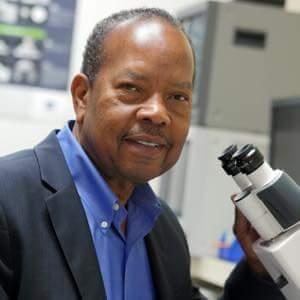
Elected to the American Academy of Arts and Sciences
A&S professor, Dr. George M. Langford, has been elected to the American Academy of Arts and Sciences. He joins Charles Darwin, Albert Einstein and Martin Luther King, Jr., as members of the Academy.
George M. Langford, A&S Dean Emeritus and Distinguished Professor of Neuroscience in the Department of Biology is among 252 new members, including media entrepreneur and philanthropist Oprah Winfrey and neurosurgeon and CNN medical correspondent Sanjay Gupta. New inductees were selected to the Academy in part for their effort in helping solve global challenges and creating meaning through art. The American Academy of Arts and Sciences was established in 1780 by John Adams, John Hancock, and others, to honor accomplished individuals and engage them in advancing the public good. The Academy’s mission is to convene members from increasingly diverse fields to share ideas and recommendations in the arts, democracy, education, global affairs, and science. Nancy Andrews, Chair of the Board of Directors of the Academy says, “We recognize individuals who use their talents and their influence to confront today’s challenges, to lift our spirits through the arts, and to help shape our collective future.”
Langford was one of nine inductees to the cellular and developmental biology section. Karin Ruhlandt, dean of A&S, says, “….I congratulate them on this career-defining achievement.” Langford, a member of the biology faculty in A&S since 2008, served as Dean of A&S from 2008-2014. His research is focused primarily on the cell and molecular biology of the actin cytoskeleton in health and disease. Langford is a member of many professional societies, including the American Society for Cell Biology, the American Association for the Advancement of Science, the Howard Hughes Medical lnstitute’s Science Education Advisory Board, and many more. Langford is also a proponent of increasing diversity in STEM. He is program director of the CHANCE project, which creates an inclusive environment for students from groups underrepresented in STEM, including minorities and first-generation students in courses in STEM departments.
Program Founded by Dr. Langford That Fosters Collaborative Network of Black Imaging Scientists Receives $1.4 Million Grant
The American Society for Cell Biology (ASCB) has received a grant for more than $1.4 million to implement a new inclusivity model and develop a more diverse scientific workforce. The grant title—Partnering to Advance Imaging Research for Underrepresented Minority Scientists Program (or PAIR-UP)—will specifically help build and support collaborative research teams of Black Imaging scientists. Langford said the program will address a major roadblock to success faced by many early career Black scientists—that is, of being the only Black faculty member in their entire department or school. Langford said the need for PAIR-UP IS “urgent” to support the careers of highly trained postdoctoral fellows.
George Langford, an ASCB Fellow and Professor of Biology from Syracuse University, who founded PAIR-UP in 2020, and who will be principal investigator, stated, “I founded PAIR-UP at Syracuse University for Black Imaging scientists who hold postdoctoral and tenure-track faculty appointments at RI universities. The program creates a self-reinforcing community (collaborative research teams) of Black scientists who are committed to helping each other sustain a strong cultural identify and sense of agency.
“…being “the only one”, Langford explained, is culturally isolating for these early career Black faculty members and puts undue emotional and psychological pressure on them as they navigate spaces in historically white colleges and universities (HWCUs).” Langford said his own career experience inspired the creation of PAIR-UP. “Over my career, I have worked at several research-intensive historically white institutions, and I was the only one, the only African American faculty member, in my department.”
Recognized for Service to American Society for Cell Biology (ASCB)
The Public Policy Committee of the American Society for Cell Biology selected George Langford to receive the 2022 Public Service Award for his 50 years of service to the ASCB and science. Langford is recognized for his national leadership and outstanding public service in support of biomedical research or advocacy of sound research policies.
In her remarks at the presentation ceremony, ASCB CEO Rebecca Alvania said, “Along with being a distinguished scientist, your career can be described in one word: Service.”
Alvania highlighted just a few of the activities Langford has been involved in. She said, “you have also contributed to the broader scientific community through your service on boards and advisory panels for critically important government agencies and foundations: the National Institutes of Health, National Science Foundation, the National Science Board, the Burroughs Welcome Fund, the Howard Hughes Medical Institute, the National Research Council, NASA, and the Marine Biological Laboratory, to name a few.”
She also listed many of the activities Langford has been involved with within the ASCB. Alvania’s list included the first chair of the ASCB Minority Affairs Committee, the chair of the ASCB Membership Committee, the chair of the ASCB Prize for Inclusivity selection committee, ASCB Treasurer, and a member of the ASCB Council.
Public Policy Committee chair Holly Goodson highlighted Langford’s most recent service project in her remarks. Goodson said, “There is no clearer example of your service to the scientific community than your work to establish and build the PAIR-UP Program….You recognized a problem – that there are too few Black imaging scientists who use advanced imaging microscopy. Instead of just recognizing that there was a problem, you went ahead and forged a solution.”
Goodson found a lesson for everyone in Langford’s years of service, especially in his development of the PAIR-UP program. Goodson said, “PAIR-UP is not just an activity that helps solve a specific problem. It is an example to the rest of our community that when we see a problem, we need to follow your lead and find a solution.”
Langford said he was humbled and honored by the recognition, and he acknowledged that his efforts are just a part of the solution.
“We need a diverse workforce to accomplish the mission of discovery and innovation required to advance scientific knowledge and improve human health,” Langford said. “This is particularly true, if we are to improve the health of the Black community and other minoritized communities. The PAIR-UP program does not require scientists to leave their culture at the door, but to be their authentic selves.”
 Langford Family